Trend simulator for RF CCP chambers
PlasmaCCPSee the plasma before you open the chamber
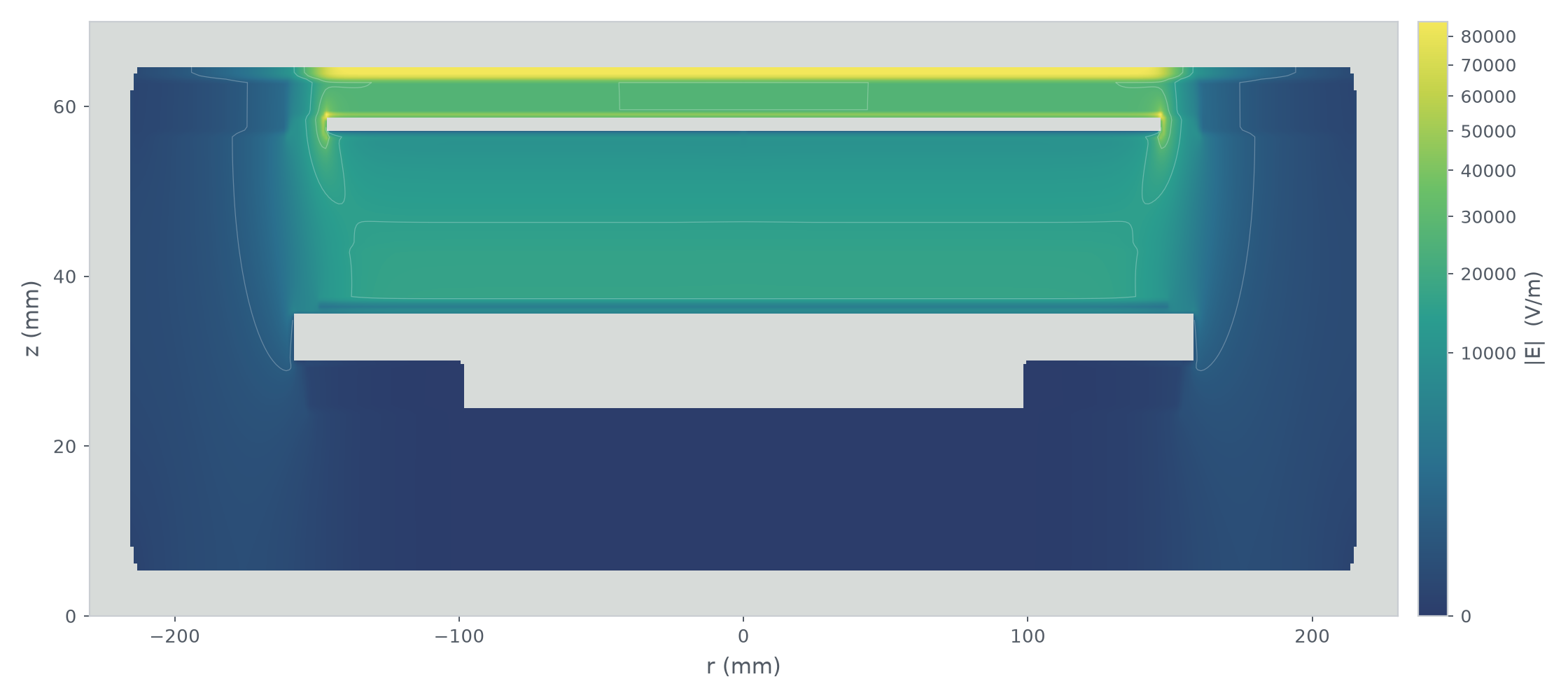
Sketch a chamber, hit run, and read the field, density, sheath and gas flow a few seconds later — cheap enough to test an idea before you book chamber time.
No account, no card. A guest run is solved in your browser, so the chamber geometry never leaves it.
| Full solve time | ~2 s | CI benchmarks | M1–M8 |
| Literature anchors | V1–V10 | Presets shipped | 24 |
§1Three questions worth answering first
The ones a screening run can actually settle.
| question | what a screening run can actually settle | |
|---|---|---|
| Where does the field pile up? | Electrode corners, dielectric joints, the sheath edge — see which ones move when you change the geometry. | |
| How does it change across the wafer? | Ion flux and ion energy along the wafer radius, so you can tell edge-heavy from center-heavy. | |
| How much of it should you trust? | The validated range, the warnings and the model's limits sit next to the numbers, not in a footnote. | |
§2Start from a chamber that looks like yours
24 process presets ship with the simulator — these six cover the common families, and every card is an actual solve of that preset.
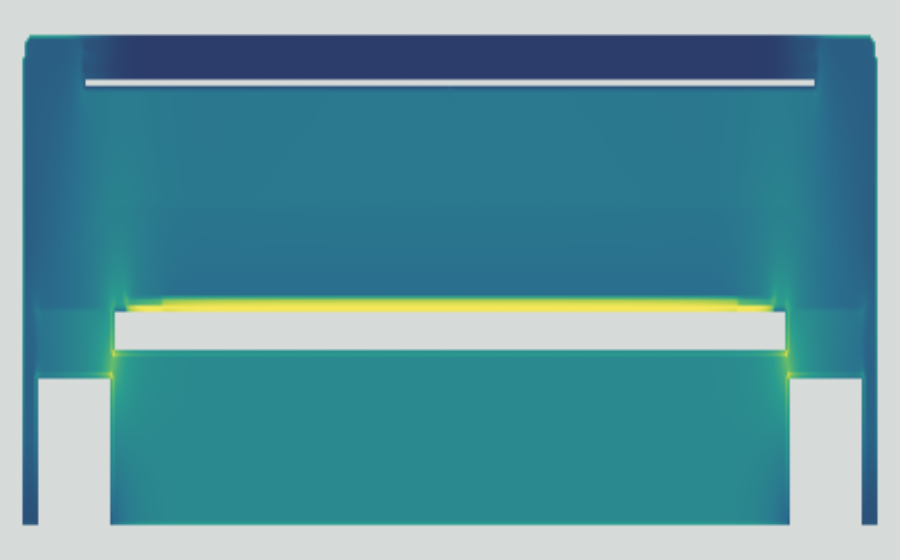
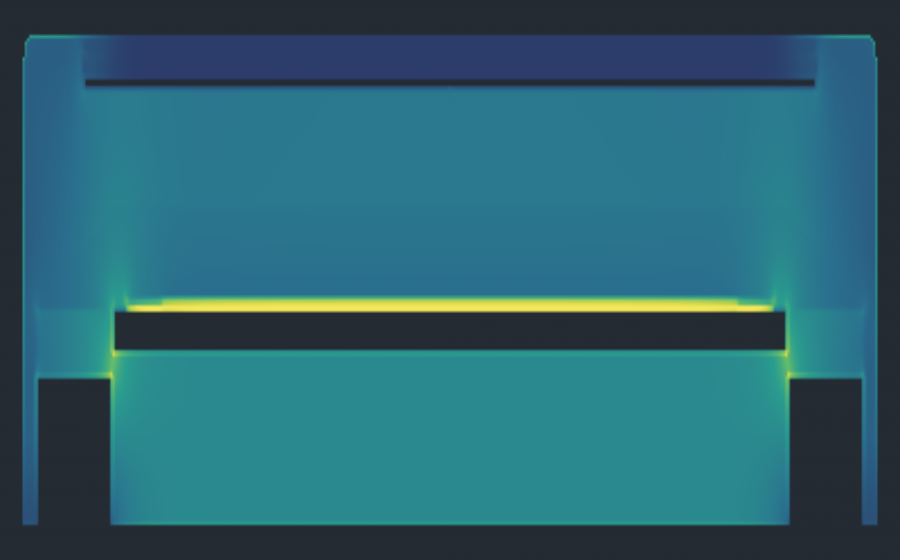
60 MHz source + 2 MHz bias, CF₄/Ar high-aspect dielectric etch.
Open preset →Plasma-ALD O2 Step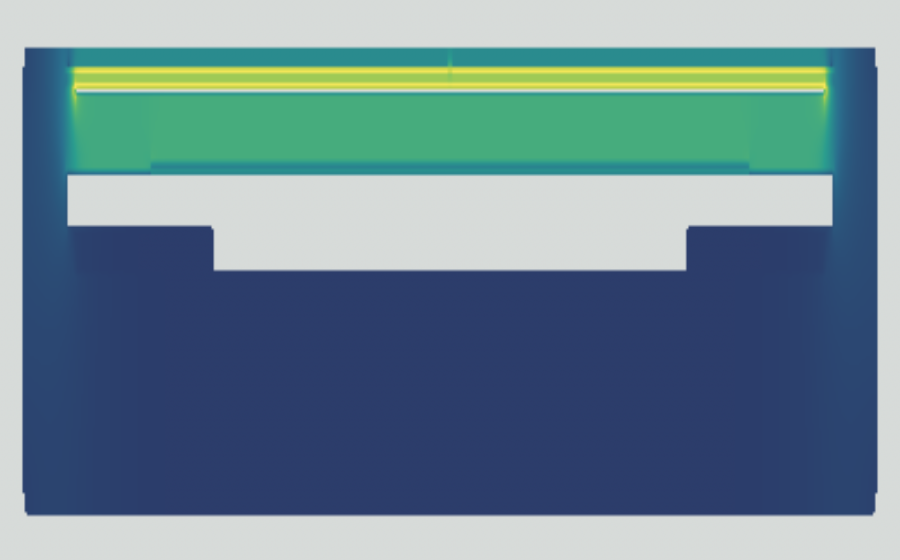
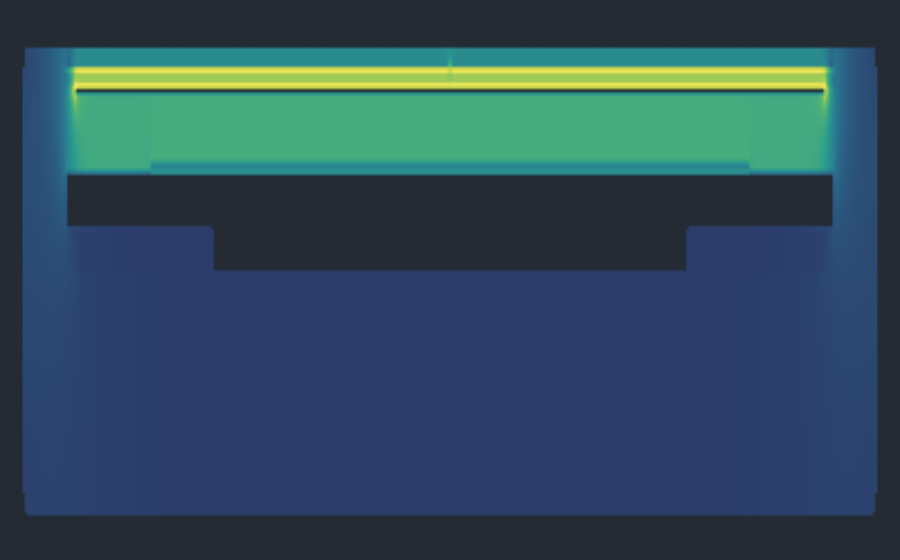
Close-coupled 6 mm gap at 8 Torr — the conductance-limited regime.
Open preset →GEC Ref Cell — Ar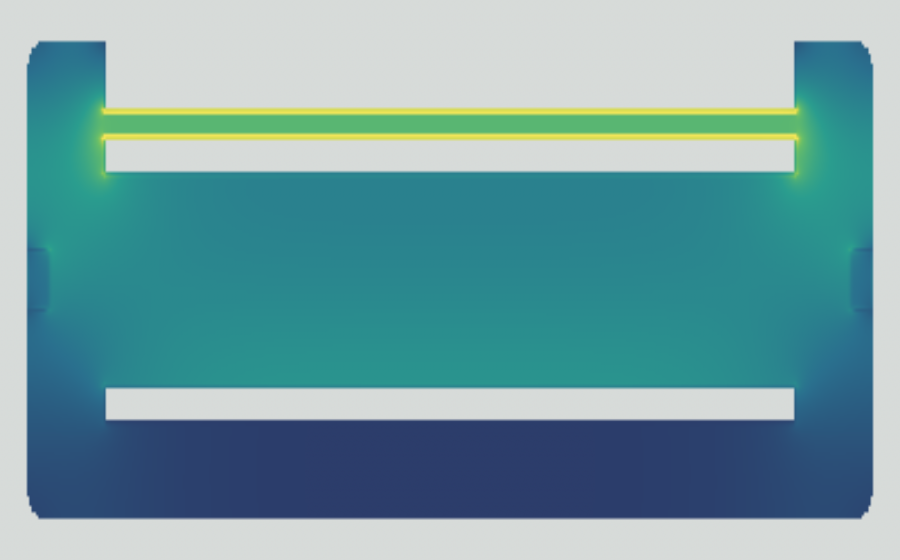
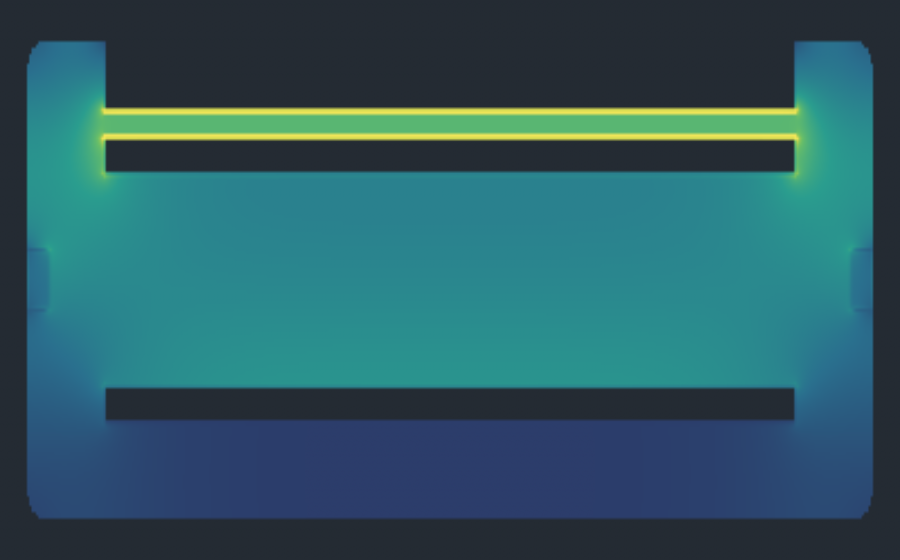
The standard research geometry (0.1 Torr Ar) — compare against published data.
Open preset →§3Your geometry never reaches our servers
If you've dropped this kind of screening because the chamber cross-section can't leave the fab, that isn't a problem here.
§3Your geometry never reaches our servers
If you've dropped this kind of screening because the chamber cross-section can't leave the fab, that isn't a problem here.
| property | behavior | |
|---|---|---|
| Guest runs | The solver is compiled to WebAssembly and runs on your machine. Nothing is solved on ours. | |
| Geometry | Not sent. A guest's only request carries 24 scalars for the judgment step — no shapes, no mesh, no snapshot. | |
| History | Nothing is kept. A guest run leaves no history entry — close the tab and it's gone. | |
| Signed in | Run history and saved geometries need the snapshot on your account. If you'd rather not, stay a guest — everything still runs. | |
§4Three steps, that's it
Draw → Run → See.
§4Three steps, that's it
Draw → Run → See.
| 01 | Draw | Sketch the chamber, or start from one of the presets. | |
| 02 | Run | One click. The reduced-fluid solver converges in a few seconds. | |
| 03 | See | Read the maps side by side and decide what to change next. | |
§5Setup, results and validation in one place
The inputs you ran, the maps they produced, and how far they've been checked — no second tool to open.
§5Setup, results and validation in one place
The inputs you ran, the maps they produced, and how far they've been checked — no second tool to open.
| parameter | value | unit | condition |
|---|---|---|---|
| Electron temperature (0D model) | 1.83 | eV | Wafer-facing plasma volume |
| Mean sheath thickness | 1.7 | mm | Powered-electrode RF mean |
| Absorbed RF power | 500 | W | 100.0% of 500 W applied |
| 2D field maps | Render |E|, electron density, and temperature straight onto the chamber cross-section. | |
| RF phase animationPro | Replay how the sheath and fields breathe over a single RF cycle. | |
| Gas flow & current streamlines | Trace neutral-gas flow and current paths as streamlines. | |
| Parameter sweepsPro | Sweep power, pressure, gap, or frequency at once to map sensitivity curves. | |
| A/B comparePro | Place two runs side by side and isolate the effect of a single change. | |
| Geometry library | Version your saved chambers and pick up any run where you left off. | |
§6We publish where we're wrong
Grounded in the literature — checked against an independent code.
§6We publish where we're wrong
Grounded in the literature — checked against an independent code.
| literature anchors (V1–V10) | 10 | CI benchmarks (M1–M8) | 8 |
| automated tests | 3,200+ | full solve | ~2 s |
§7One run is never the answer
An engineering call is always A versus B. Wider electrode, tighter gap, different focus ring — these tools exist to make that comparison directly.
§7One run is never the answer
An engineering call is always A versus B. Wider electrode, tighter gap, different focus ring — these tools exist to make that comparison directly.
| tool | what it does | |
|---|---|---|
| A/B comparePro | Two chambers, same recipe, side by side | |
| Split testPro | Change one thing at a time and isolate its effect | |
| Parameter sweepPro | Walk pressure, power or frequency into a trend line | |
| Calibration | Fit the model to a measured point | |
| Drift diagnosis | Work backwards from a chamber that changed | |
All of these need an account; the three marked Pro open on the paid plan. Single runs stay free with no account.
§8Pricing
The Free plan is fully usable today. Pro adds the sweep, A/B compare, and split-test workflows plus a higher mesh ceiling — paid checkout is not open yet.
§8Pricing
The Free plan is fully usable today. Pro adds the sweep, A/B compare, and split-test workflows plus a higher mesh ceiling — paid checkout is not open yet.
| plan | price | includes | |
|---|---|---|---|
| Free | $0 |
| |
| Pro | Soon (Coming soon) |
| |
Run your first chamber now
About this model
PlasmaCCP is a reduced fluid model built for fast trend screening. Results are directional signals — confirm findings with experiments or high-fidelity simulation before sign-off. Read validation and references.